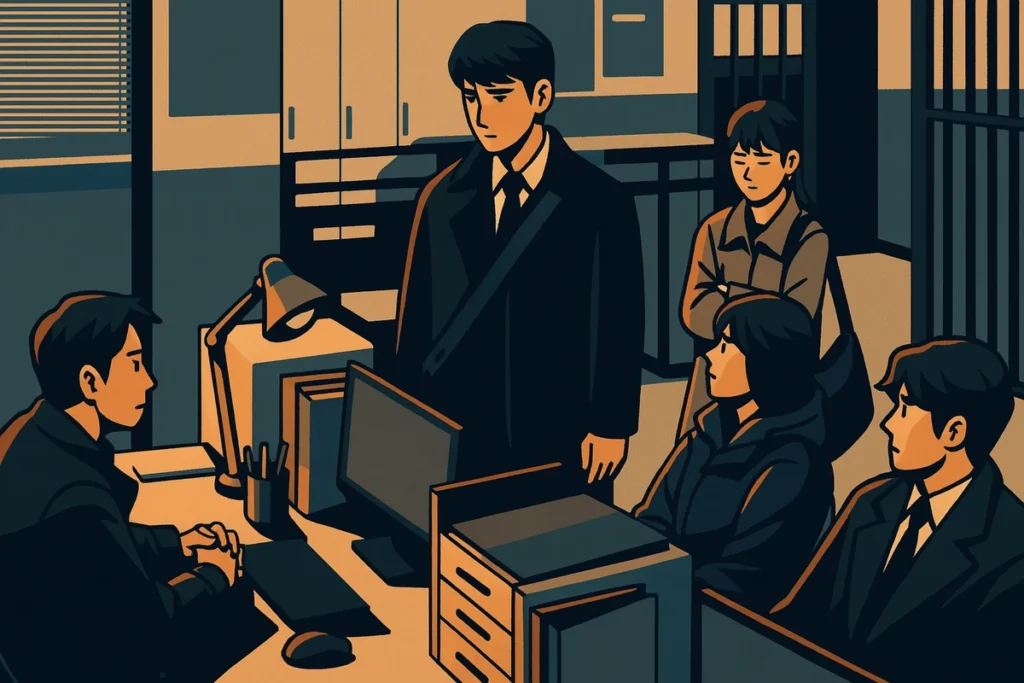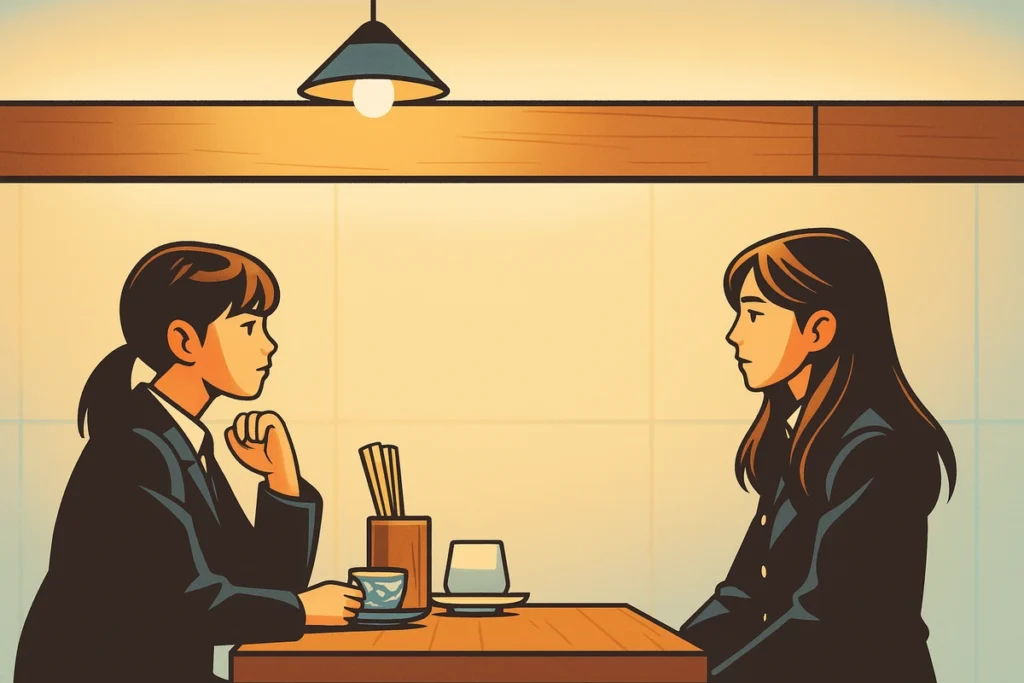
[Image Source] AI illustration by DALL·E
TL;DR – Polite words can cut the deepest.
A simple café meeting turns into a storm of shame in Our Unwritten Seoul.
Mistaken identity, passive-aggressive honorifics, and public confrontation collide—revealing how language in Korean dramas is more than just words.
This post dissects how indirect speech, tone, and social expectations shape the tension—and teaches you how to navigate those sharp-edged phrases.
 To protect copyright, all dialogue has been rephrased while preserving the original context. I appreciate your understanding.
1. Scene Snapshot
A crowded café. An unsuspecting woman. And a storm of humiliation that crashes out of nowhere. Mi-ji is quietly waiting for a friend when a sharply dressed woman—furious, scornful—confronts her without warning. She hurls cutting accusations, mixing politeness with poison, convinced Mi-ji is having an affair with her husband. Mi-ji freezes. She stammers, confused, trying to understand who this woman is and what she’s done wrong. In Korean dramas, mistaken identity often leads to chaos—but this scene burns deeper. It isn’t just a case of “Oops, wrong person.” It’s a public attack, laced with sarcasm and condescending honorifics. Every line drips with controlled rage. Just as things escalate, Ji-yoon arrives—a fierce, loyal friend who steps in and flips the entire situation with just a few biting words. For learners, this scene is a crash course in real-life Korean confrontation: how indirectness turns sharp, how sarcasm hides behind politeness, and how friends defend each other with fearless informal speech. You’ll hear tone shifts, hesitation patterns, and key expressions that can’t be found in any textbook.
📺 Watch the original scene here
[Source] YouTube, 샾잉
2. Micro-Dialogue
아… 저는 친구 기다리는 중이라서요. 자리 비어 있는데요?
→ Uh… I’m just waiting for a friend. Is this seat open?
Variants: 일행이 아직 안 와서요 / 여기 누가 앉기로 했는데요?
잠깐만요. 누구신데 저한테 이러세요?
→ Excuse me—who are you, and why are you doing this?
Variants: 실례지만 저랑 무슨 관계세요? / 왜 이러시는 거예요?
그럼 당사자한테 가세요. 왜 엉뚱한 사람을 괴롭히세요?
→ Then go talk to the actual person. Why accuse the wrong one?
Variants: 그 사람한테 직접 말하세요 / 저한테 그러실 이유 없잖아요
사람 잘못 봤으면 사과는 하셔야죠.
→ If you got the wrong person, shouldn’t you at least apologize?
Variants: 실수했으면 인정하셔야죠 / 착각하신 거면 미안하다고 하셔야죠
3. Culture & Subtext
3-1. Condescending honorifics
Park Sang-young’s wife weaponizes politeness. Instead of yelling informally, she uses sharp honorifics like “-세요” and “-시” with sarcastic undertones. This creates a chilling effect—passive-aggressive and socially cutting. Korean learners must grasp how tone overrides surface form.
3-2. Shame and 체면 (saving face)
Words like “염치” carry heavy moral judgment. Accusing someone of lacking 염치 is like attacking their integrity. In Confucian-influenced Korean culture, public shame can be more devastating than private anger.
3-3. False accusations in public
Public confrontation is rare in Korea. When it happens, it feels ten times more intense because it violates the unspoken rule of decorum. Ji-yoon’s intervention restores justice without breaking that rule.
3-4. Omissions with emotional punch
Phrases like “그게 무슨…” trail off mid-sentence not because of laziness, but because of discomfort or disbelief. Koreans often leave things unsaid when emotions are too strong to finish the thought.
3-5, Friendship and speech shift
Ji-yoon’s use of 반말 to protect Mi-ji flips the entire power dynamic. In Korean, solidarity often shows more in speech level than actions—and her casual “야 미지야, 가자” lands harder than any formal protest.
❓ FAQ (Frequently Asked Questions)
Q1. Why does “염치도 없네” hit so hard in Korean?
→ The word “염치” isn’t just about manners—it implies shame, dignity, and moral obligation. Saying someone has no 염치 is a character attack. On Reddit, Korean learners often mention this phrase as one of the most brutal indirect insults in dramas.
Q2. Why is the angry woman speaking in polite language? Isn’t that contradictory?
→ In Korean, 존댓말 (honorific speech) isn’t always kind. It can be used sarcastically, mainly to show moral superiority or passive-aggression. This is often more intimidating than yelling in 반말. Learners on Quora note how this kind of speech “hurts more because it sounds formal.”
Q3. What’s the deal with “아니, 누구신데요?”—isn’t that rude?
→ Surprisingly, no. It’s a polite sentence structurally, but in tone it expresses protest, disbelief, or boundary-setting. It’s one of the most common ways Koreans push back without outright conflict. This line shows up frequently in confrontation scenes and is often misunderstood by learners.
Q4. Why is Ji-yoon switching to 반말 like “야, 가자”? Isn’t that informal?
→ Exactly—and that’s the point. In Korean, switching from formal to informal speech signals intimacy, loyalty, and protection. Ji-yoon’s 반말 flips the power balance: she’s saying, “I’ve got your back,” not just “let’s go.” Reddit users often highlight this kind of speech shift as a powerful emotional cue in drama friendships.
Q5. Are public confrontations like this common in Korea?
→ Not at all. That’s why it feels so intense. Korean society values face-saving (체면), so public shame scenes carry extra emotional weight. When they happen in dramas, they’re usually designed to be unforgettable—and culturally shocking to locals and foreigners alike.
4. Grammatical Analysis of the Dialogue
4-1. “저, 그게… 아직 제 친구가 안 와서요. 여기 앉아도 되나요?”
Would it be okay if I sit here? My friend hasn’t arrived yet…
🔍 Analysis
– 저, 그게…: Repetition and filler phrases like “그게” indicate hesitation, nervousness, or emotional pressure in Korean.
– 아직 제 친구가: 아직 (still, yet) + 제 (humble form of ‘my’) + 친구 (friend) + subject particle -가
– 안 와서요: 오다 (to come) → negative form 안 오다 + connector -아서요 (because)
– 여기 앉아도 되나요?: 앉다 (to sit) + -아도 되다 (permission) + -나요? (tentative interrogative ending)
📌 Example Usage
“아직 동행이 안 와서 잠깐 여기 앉아 있어도 될까요?”
“My companion hasn’t arrived yet—may I wait here for a moment?”
☀️ Meaning
A polite, flustered attempt to defend one’s presence in a public space.
The structure “-아도 되나요?” adds a respectful, deferential tone, while “그게…” signals anxiety or fear of confrontation.
🧩 Similar Patterns
– “여기 자리 비었어요?” – Is this seat empty?
– “지금 앉으면 안 되나요?” – Is it not okay to sit here now?
💬 Usage & Variation
Formal / Respectful: “잠시 앉아 있어도 괜찮을까요?”
→ Would it be alright if I sit here for a moment?
Polite / Soft: “여기 앉아도 돼요?”
→ Is it okay if I sit here?
Casual / Friendly: “나 여기 앉아도 되지?”
→ I can sit here, right?
4-2. “양심 좀 있으세요. 남의 일에 왜 이래요?”
Have some conscience. Why are you meddling in someone else’s business?
🔍 Analysis
– 양심 좀 있으세요: 양심 (conscience, moral sense) + softener 좀 + 있으세요 (honorific form of 있어요); structure implies moral judgment, not a literal question.
– 남의 일에: 남의 (someone else’s) + 일 (affair, matter) + location marker -에
– 왜 이래요?: 왜 (why) + 이러다 (to act this way) in polite interrogative form
📌 Example Usage
“다 큰 어른이면 양심은 좀 있어야죠.”
“As a grown adult, you should have some conscience.”
☀️ Meaning
A passive-aggressive accusation wrapped in polite form.
“좀 있으세요” isn’t a suggestion—it’s a rebuke implying the speaker sees the other person as immoral or shameless.
🧩 Similar Patterns
– “염치 없으세요?” – Don’t you have any shame?
– “선 넘지 마세요.” – Don’t cross the line.
💬 Usage & Variation
Aggressive: “그쪽이 뭔데 참견하세요?”
→ Who do you think you are to butt in?
Polite but Sharp: “다른 사람 일엔 조심하셔야죠.”
→ You really should be more careful with other people’s business.
Sarcastic: “오, 정의감 넘치시네요?”
→ Wow, overflowing with righteousness, aren’t we?
4-3. “잠깐만요. 누구시길래 이러세요?”
Excuse me, who are you to act like this?
🔍 Analysis
– 잠깐만요: Polite interjection for “wait a moment,” commonly used in objection or protest
– 누구시길래: 누구 (who) + honorific “-시-” + -길래 (reason/cause marker: “that you would…”) → implies disbelief
– 이러세요: 이러다 (to act like this) + honorific polite question form
📌 Example Usage
“누구시길래 저한테 이런 말을 하세요?”
“Who are you to talk to me like this?”
☀️ Meaning
She’s protesting while maintaining politeness.
“누구시길래” is emotionally charged—it questions both identity and authority.
🧩 Similar Patterns
– “어디서 오셨는데 이러세요?” – Where are you from, acting like this?
– “저랑 무슨 관계시죠?” – What’s your relation to me?
💬 Usage & Variation
Blunt / Stern: “정체가 뭔데 이러십니까?”
→ Who exactly are you to act like this?
Cautious / Careful: “실례지만 누구신지 여쭤봐도 될까요?”
→ Excuse me, may I ask who you are?
Cynical / Dry: “갑자기 왜 이러세요?”
→ Why are you suddenly acting like this?
4-4. “그분 여기 안 계세요. 괜히 엉뚱한 사람한테 뭐라 하지 마세요.”
That person isn’t here. Don’t take it out on the wrong person.
🔍 Analysis
– 그분 여기 안 계세요: 그분 (that person, polite) + 여기 (here) + 없다 in honorific negative present 안 계세요
– 괜히: in vain / without reason / unnecessarily
– 엉뚱한 사람한테: 엉뚱한 (wrong, unrelated) + 사람 (person) + direction marker -한테
– 뭐라 하지 마세요: 뭐라 하다 (to criticize, say something harsh) + -지 마세요 (negative imperative)
📌 Example Usage
“여기 계신 분한테 그러지 마세요. 잘못 짚으신 거예요.”
“Don’t say that to this person—you’ve got the wrong one.”
☀️ Meaning
A gentle but firm correction that someone’s misdirecting blame.
“엉뚱한 사람한테 뭐라 하지 마세요” holds the moral high ground without raising one’s voice.
🧩 Similar Patterns
– “그분은 이 자리에 안 계세요.”
– “헛다리 짚지 마시고, 사실부터 확인하세요.”
💬 Usage & Variation
Formal / Respectful: “그 말씀은 본인께 직접 하셔야겠네요.”
→ You should really say that directly to the person involved.
Sharp / Direct: “아닌 사람 붙잡고 뭐 하시는 거예요?”
→ Why are you confronting the wrong person?
Casual / Friendly: “지금 딴 사람한테 뭐라는 거야?”
→ Why are you going off on the wrong person right now?
4-5. “야, 미지야. 일어나자.”
Hey, Mi-ji. Let’s get up.
🔍 Analysis
– 야: Casual interjection for grabbing attention, often used among close friends
– 미지야: Name “미지” + vocative suffix “-야” (informal call)
– 일어나자: 일어나다 (to get up/stand up) + suggestion form –자 (let’s)
📌 Example Usage
“야, 수연아. 자리 옮기자.”
“Hey Suyeon, let’s change seats.”
☀️ Meaning
This is more than “let’s leave”—it’s rescue in a single line.
“야, 미지야. 일어나자.” conveys warmth, loyalty, and emotional protection in casual speech.
🧩 Similar Patterns
– “그만하자.” – Let’s stop.
– “자리 옮기자.” – Let’s move.
– “우리 나가자.” – Let’s head out.
💬 Usage & Variation
5. Natural Korean Toolkit
미쳤어
Are you crazy? / What the hell?
Alternative Expressions: 제정신이야? 왜 이래
Used when someone crosses the line or shocks you. Tone depends on delivery—can be furious, scared, or half-joking.
아닌데요
That’s not true / Excuse me?
Alternative Expressions: 뭔 소리예요? 그런 적 없는데요
A calm way to defend yourself, often paired with a confused or deflecting tone. Adds distance without confrontation.
가자
Let’s go
Alternative Expressions: 나가자, 빨리 가
Simple and urgent. Common among close friends or when someone needs to be rescued from an awkward or hostile situation.
헛다리 짚지 마
Don’t bark up the wrong tree.
Alternative Expressions: 헛소리 하지 마, 오해하지 마
Blunt and dismissive. A strong way to say “You’re way off,” often used when someone wrongly accuses or misjudges the situation.
자리 있어요?
Is this seat taken?
Alternative Expressions: 여기 앉아도 돼요?, 사람 있어요?
Polite way to claim space in a public setting. Useful for cafes, waiting areas, or navigating tense social territory, as seen in this scene.
6. Quick Quiz or Expression Drill
Fill in the blanks with the correct Korean expression based on the scene.
6-1. “___, 지금 왜 이러세요?”
6-2. “그분은 여기 안 계세요. ___ 짚지 마세요.”
6-3. “야 미지야, ___.”
6-4. “저는 아직 친구가 ___ 가지고…”
6-5. “양심은 좀 ___야죠.”
Choose the most natural Korean response.
6-6. You’re wrongly accused and want to object politely. What do you say?
a) 아닌데요
b) 진짜요?
c) 나가자
6-7. Your friend is being confronted unfairly, and you want to help her leave.
a) 자리 있어요?
b) 헛다리 짚지 마
c) 야, 가자
6-8. A stranger suddenly says something outrageous. How do you react?
a) 제정신이에요?
b) 안녕히 계세요
c) 죄송합니다
📍 Want to Understand the Korean Behind the Drama?
Go beyond the scene with these essential posts—learn how omission, tone, formality, and ambiguity shape real Korean conversations just like Mi-ji and Ho-su’s.
- 🔖 Beyond Grammar: The Art of Omission in Korean
- 🔖 Understanding Korean Ambiguity: A Guide to the Beauty of Multilayered Expressions
- 🔖 Mastering Korean Honorifics: A Guide to Respectful Communication in Korean Culture
- 🔖 Korean Honorifics vs. Informal Speech: Master the Basics with Practical Examples
🎥 Want more about this drama’s language and themes?
Explore more posts in our K-Drama Bites series and learn how Korean drama lines reveal everyday emotion, grammar, and cultural nuance.
- 🔖 Learn Legal Korean from K-Drama: What “I Won’t Withdraw” Really Means in ‘Our Unwritten Seoul’
- 🔖 Learn Korean with an Ordinary Scene from Our Unwritten Seoul
- 🔖 Learn Korean with a Morning Panic Scene from ‘Our Unwritten Seoul’
- 🔖 Learn Korean with a Public Confrontation: Mistaken Identity and Sarcasm in “Our Unwritten Seoul”
- 🔖 Twin Identity & Korean Phrases: Language Lessons from Our Unwritten Seoul Shorts
Answers
6-1. 아니
6-2. 헛다리
6-3. 나가자
6-4. 안 와
6-5. 있어
6-6. a) 아닌데요
6-7. c) 야, 가자
6-8. a) 제정신이에요?